

Last Updated May 7, 2026
Temporary work is often considered a lower-cost, lower-value alternative to full-time employment. But that gap has been steadily closing, and in some industries, that perception is already outdated.
While temp worker pay has risen, agency pricing has not kept pace and is increasing at a slower rate than broader industry prices. This suggests that staffing firms may be absorbing rising labor costs rather than fully passing them on to clients.
To understand where this is happening the most, we analyzed hourly wage and Producer Price Index (PPI) data from the Bureau of Labor Statistics, comparing temp and full-time pay across occupations and tracking how this relationship has changed over time.
Temping vs. Wider Average
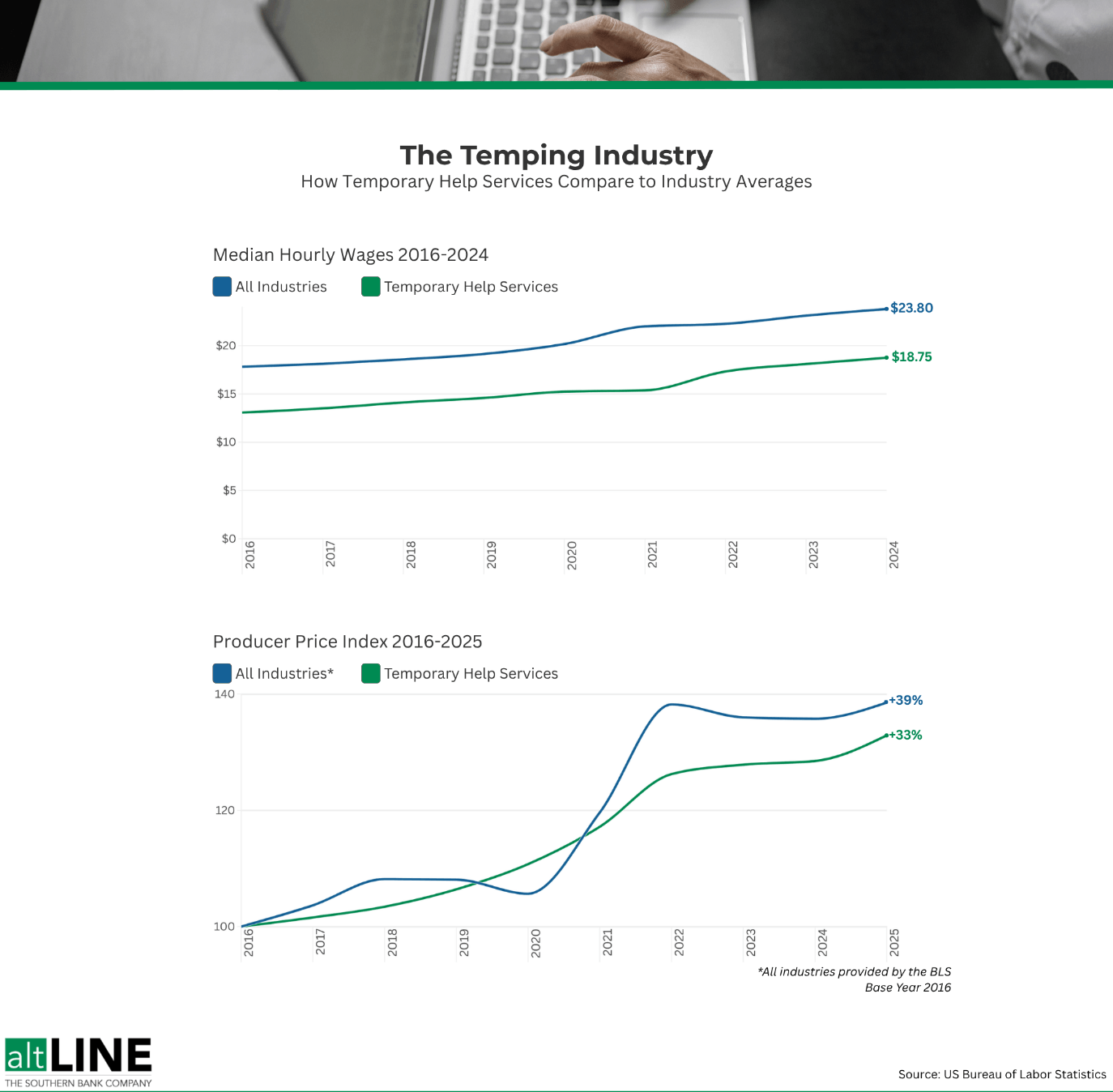
In 2016, the median hourly wage across all U.S. industries was $17.81, but temp workers were typically being paid 27% less, at $13.07. By 2024, these wages reached $23.80 and $18.75, respectively, meaning the wage gap had shrunk to 21%.
This means that temp workers’ salaries are gradually catching up to those of their full-time colleagues and, therefore, becoming a viable employment option for more people.
To understand how this shift fits into the broader economy, it’s useful to look at the Producer Price Index (PPI), published by the Bureau of Labor Statistics. The PPI measures how the price of industry output changes over time. For the temp industry, it reflects how much agencies are charging their clients for their workers’ time.
The PPI growth in the temp industry has been lower than that of the average industry, meaning that businesses are increasing prices in their own industries faster than staffing agencies are increasing their bill rates.
What’s more, the temp industry’s PPI has risen by an average 3.7% per year from 2016 to 2025. Meanwhile, temp wages have grown by an average 5.4% per year, meaning that more of the revenue generated by the staffing industry is reaching workers.
This all suggests that staffing agencies may be taking a smaller cut than they used to, both relative to their workers’ wages and to the broader economy.
Not all temp roles are equal, however. We’ve shown they are becoming more competitive overall, but which roles are best suited for temporary work, whether working as or hiring a temp?
The Fields Paying Temps the Most
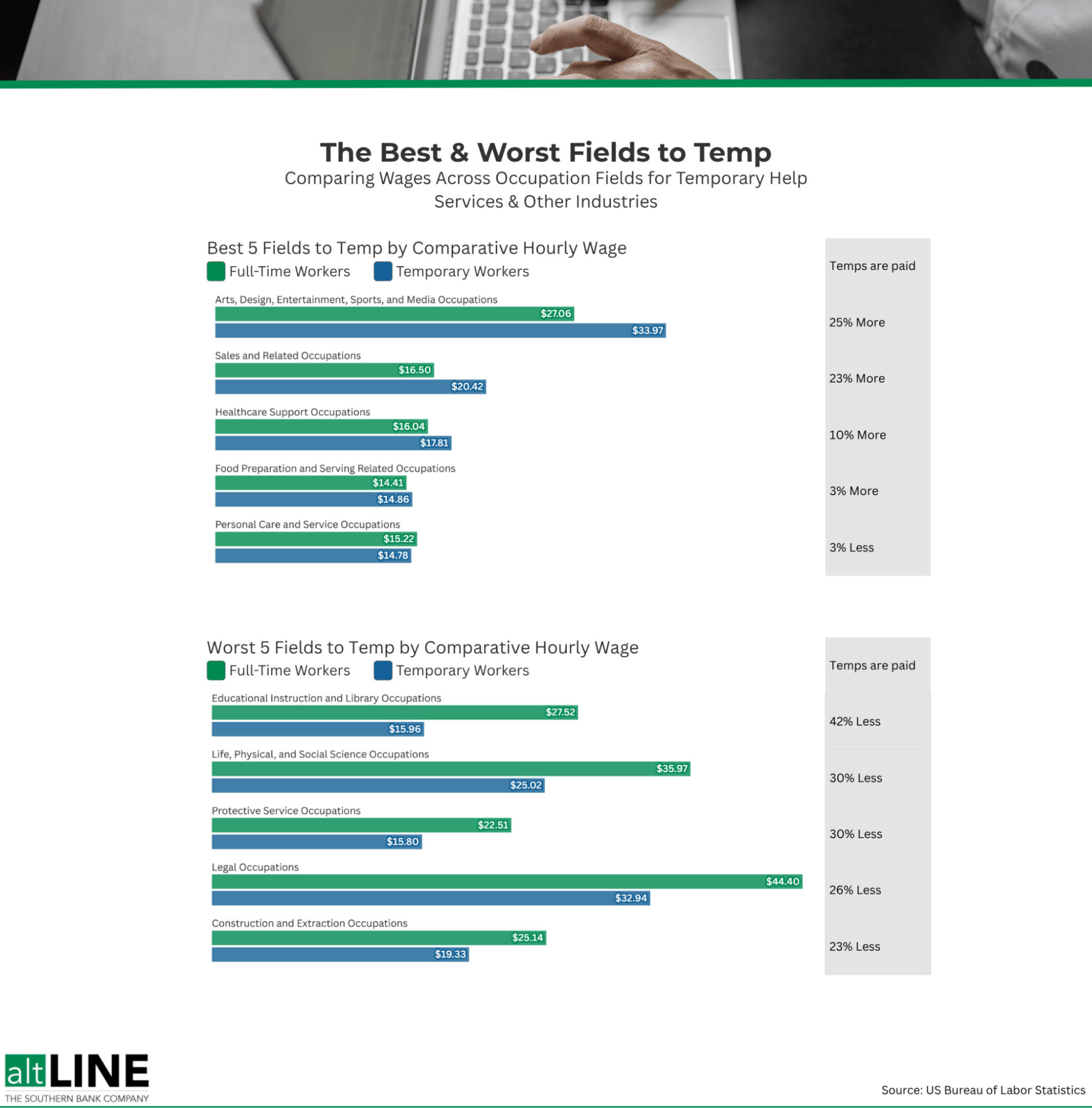
The BLS categorizes all occupations in the U.S. into 22 major fields. Among these fields, only four see temp workers typically paid more than their full-time counterparts.
The five occupations that pay temporary workers the best and worst rates, compared to full-time employees, are shown below. If you are interested in seeing how your own or other occupations stack up, the full data tables can be found at the bottom of the page.
Arts, Design, Entertainment, Sports, and Media occupations, along with Sales-related roles, stand out as the only fields in which temp workers typically earn more than 20% higher than full-time wages.
In the remaining 18 fields, temp workers typically earn less. The largest gap appears in Educational Instruction and Library occupations, where temp workers are paid more than $11 less per hour, nearly half the full-time rate.
However, averages at the field level can mask important differences. Some roles within a field are more commonly filled by temporary workers, which can skew overall wage comparisons. For instance, the “gig economy” in the Arts & Media field offers workers higher pay than traditional temp staffing.
To uncover these differences, we next narrowed the analysis to more specific occupations.
The Most Valuable Roles
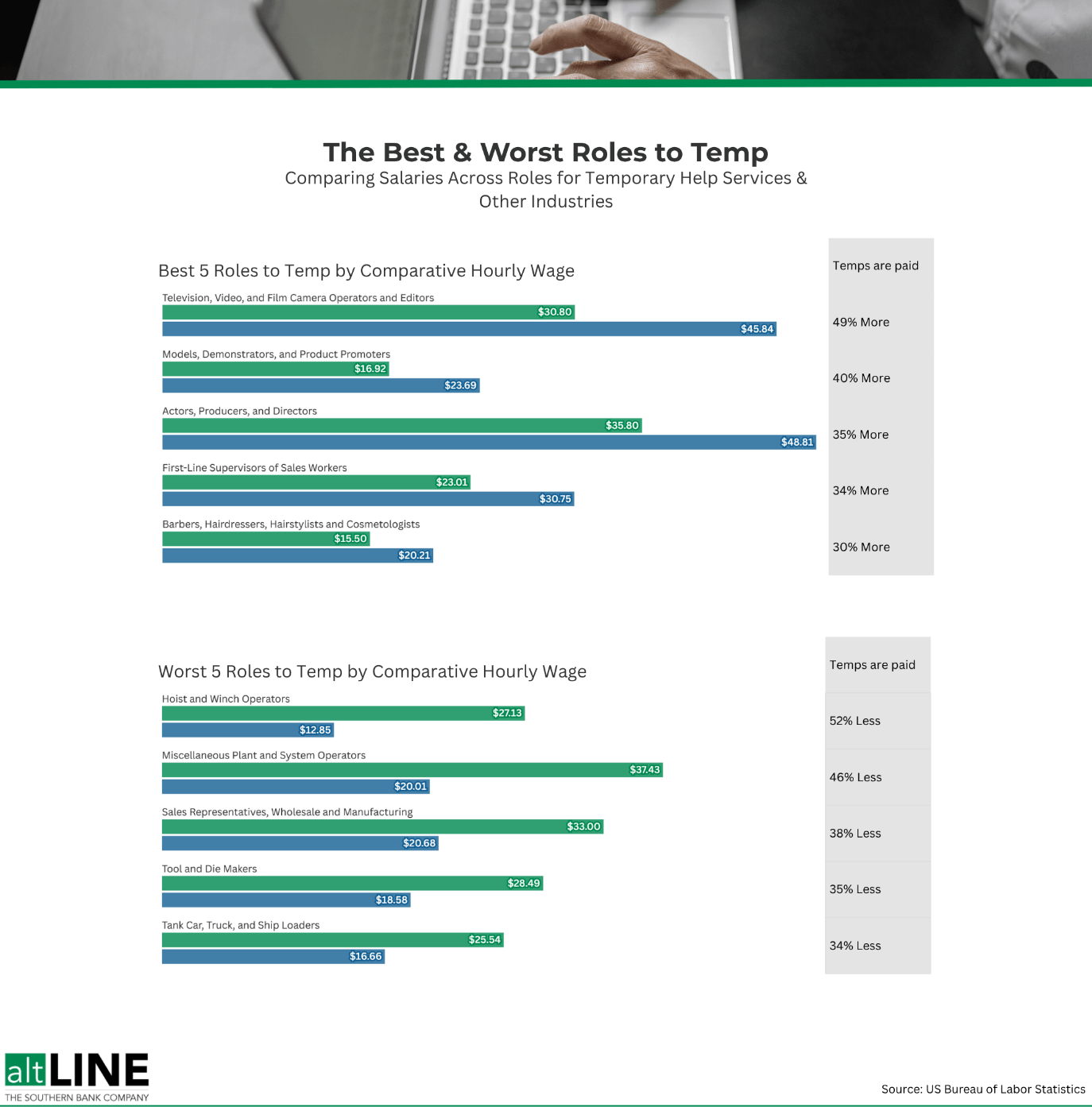
Looking into more detailed occupational categories, we see larger pay differences begin to emerge, but also trends in role types start to appear more clearly.
The trend seen at the broader level continues here, with media and sales roles being the relatively best-paid positions for temporary workers. Gig economy media occupations, such as Film Camera Operators and Editors, as well as Actors, Producers, and Directors, stand out again as roles that pay significantly more to temporary workers.
In fact, across the top 5 best roles to temp, we see a trend for beauty, media, and entertainment roles. Similarly, when examining the five worst roles for temporary work, a trend emerges in technical manufacturing and heavy machinery.
The divide may suggest roles that require specialized training or have strict health and safety compliance requirements, and value temporary workers less.
With this analysis, we’ve captured a snapshot of how temporary workers are paid, but the labor market is always changing, particularly with AI developments. To understand how things are changing, we next explored how the pay balance between temporary and full-time workers has changed since 2020.
Temp-Leaning Fields
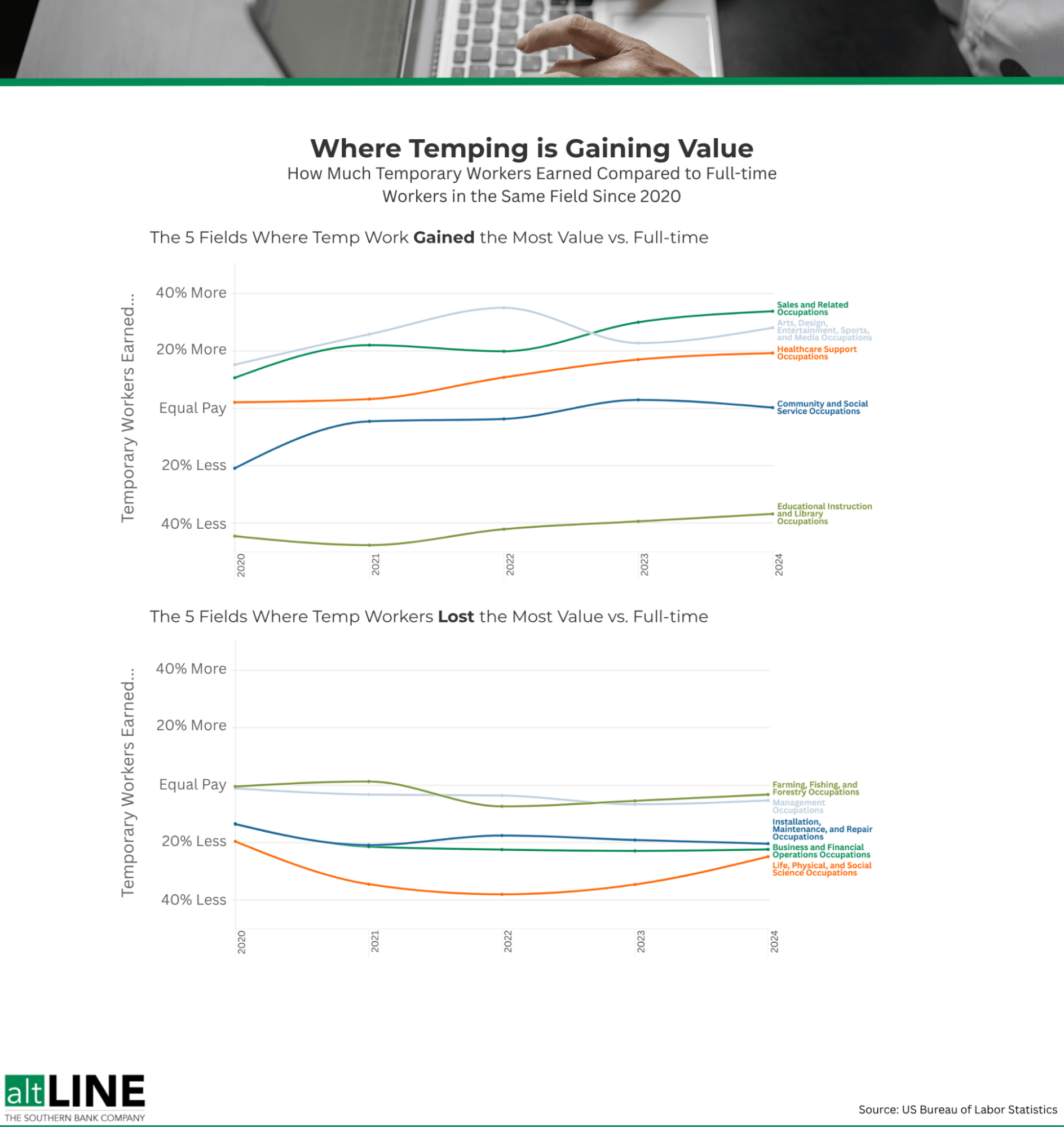
We compared temporary workers and full-time employees across the 22 major occupational fields and ran the analysis for each year from 2020 to 2024 to see which occupations are becoming more or less favorable to temp workers.
Sales-related roles grew the most over the period. In 2020, temporary workers in these roles were typically paid about 11% more than full-time employees; by 2024, this premium had grown to 34%.
Community and Social Service occupations saw the second-largest increase and may be the most notable among them. Over the period, temp workers went from earning 21% less than full-time employees to reaching wage parity.
In contrast, for the fields where temp work lost value, the changes were more modest. Wages fell the most for temporary workers in Business and Financial Operations compared to their full-time counterparts, but this change was from 13% less to 22% less, a comparatively small drop of just 9%.
As before, the next step was to delve into more specific occupations to find the finer details and the individual roles that changed most.
Specific Roles Trending to Temping
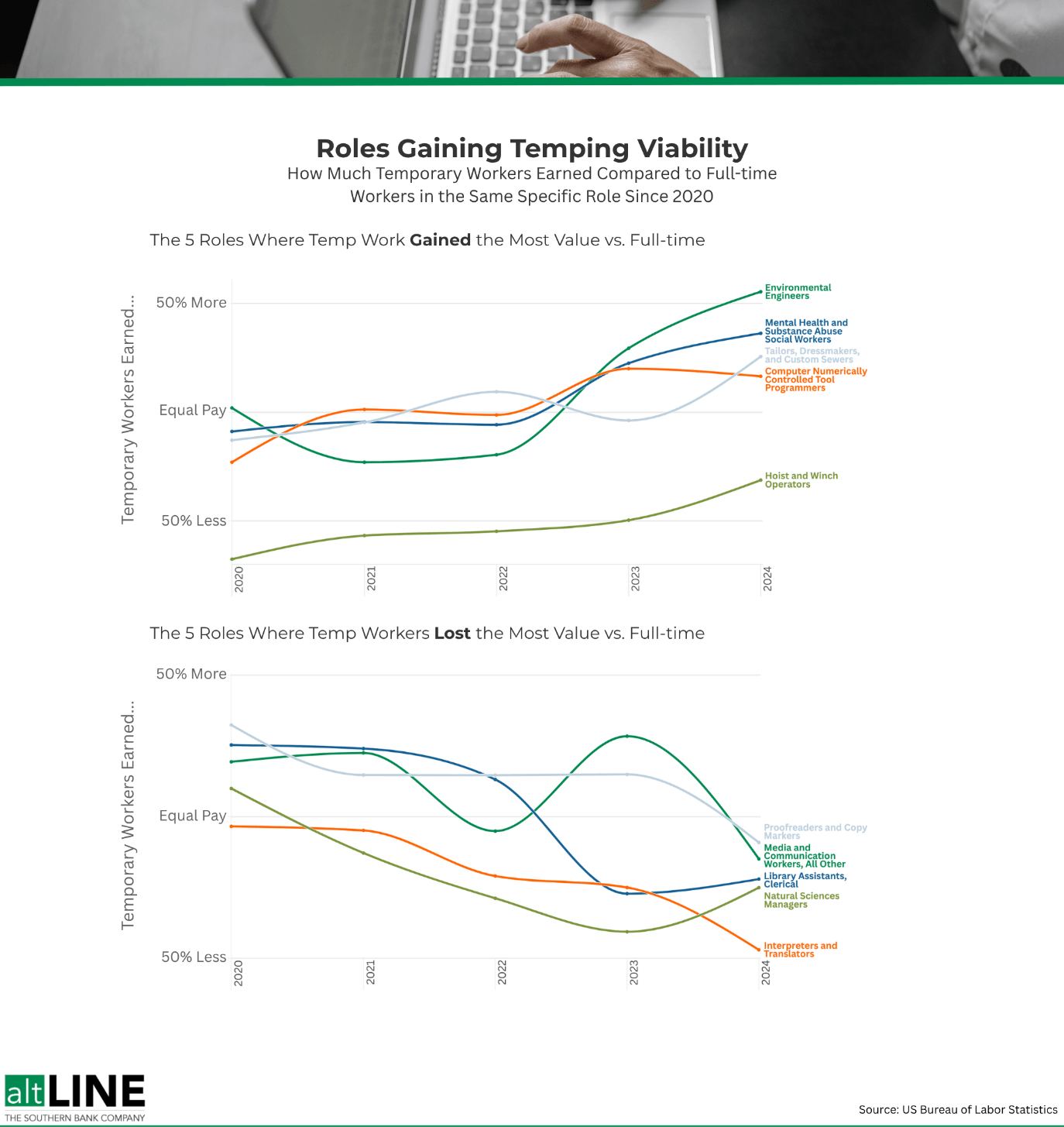
At a more detailed occupational level, the shifts become even more pronounced.
Environmental Engineers saw the greatest shift in value over the period, rising from roughly equal pay to temporary workers earning a massive 55% more than full-time employees.
At the other end of the spectrum, Library Assistants (Clerical) experienced the sharpest decline. In 2020, temp workers in this role earned around 25% more than their full-time counterparts, but by 2024, this had reversed to a 22% pay deficit.
Notably, there has been a decline in the relative pay of temporary Proofreaders & Copymarkers and Interpreters & Translators. According to research by Microsoft, these roles are among those most exposed to AI development, with Interpreters & Translators having the highest exposure overall. This could indicate that temporary workers in these roles are among the first to be impacted by increased AI automation.
As the analysis becomes more specific, larger swings in relative pay become more visible. However, it is worth noting that the results also become more volatile due to the specificity. For example, there were, on average, only around 450 Environmental Engineers working as temporary workers each year, so the influence of each individual’s wage on the overall average is much stronger.
This means that while these results are still a fair representation of true temporary workers’ pay, they should be interpreted with more caution than the broader occupational trends discussed earlier.
Conclusion
Temporary work is becoming a more financially viable option for workers and hiring costs for businesses are increasing slower than wider industry averages, making the future of temping look like a win-win. However, this is not the case across the entire labor market.
Full-time employees continue to earn more in the majority of roles, despite a few occupations that contradict this. There are occupations in which temp workers’ wages were significantly behind a few years ago and have now achieved pay parity. And there are also fields in which the opposite is true. The general trend, however, is that temporary workers’ wages are catching up to their full-time counterparts.
New technology will continue to shape the workforce, and both full-time and temp workers will need to adjust. Tracking and understanding the value of temporary workers and their placements will be key to how organizations structure their workforce in the years ahead.
Full Data
Want to explore the complete dataset and see how every occupation compares? View the full analysis and data tables here.
Methodology
PPI and wage values were sourced from the BLS.
Median hourly wage values were used for each year, occupation, and industry. To calculate overall wage averages for the last 5 years, the mean of these medians was used.
Occupations with an unpublished number of employees by the BLS, either due to the number being too low or security reasons, were excluded.
Likewise, roles missing data (likely due to occupations being recategorized, added, or removed) were excluded from the analysis. These roles are still included in the full data tables.
For occupational “fields” (seen in “The Best & Worst Fields to Temp” and “Where Temping is Gaining Value”), the BLS “Major” Occupation group was considered.
For occupational “roles” (seen in “The Best & Worst Roles to Temp”), the BLS “Broad” Occupation group was considered.
For occupational “specific roles” (seen in “Roles Gaining Temping Viability”), the BLS “Detailed” Occupation group was considered.
When considering the “5 specific roles gaining/losing the most value”, roles with a single outlier year were excluded.

Michael McCareins is the Content Marketing Associate at altLINE, where he is dedicated to creating and managing optimal content for readers. Following a brief career in media relations, Michael has discovered a passion for content marketing through developing unique, informative content to help audiences better understand ideas and topics such as invoice factoring and A/R financing.