
Last Updated January 5, 2026
The Federal Motor Carrier Safety Administration’s (FMCSA) emergency interim ruling on non-domiciled Commercial Driver’s Licenses (CDLs) has sparked widespread debate and concern across the trucking industry.
Our team conducted a sentiment analysis of public comments submitted to FMCSA through the regulations.gov portal regarding the rule, offering insight into how drivers, carriers, and other industry stakeholders are reacting to the decision and its potential consequences.
Background: Non-Domiciled CDLs and the FMCSA Rule
Non-domiciled CDLs are licenses issued to individuals who are legally in the U.S. but do not meet a state’s full residency requirements. These licenses allow qualified non-citizen drivers, such as asylum seekers and individuals in the process of obtaining permanent residency, to legally operate commercial vehicles.
In late September 2025, FMCSA issued an emergency “interim final rule” titled Restoring Integrity to the Issuance of Non-Domiciled Commercial Driver’s Licenses, tightening restrictions on who can obtain or renew these licenses. This rule went into effect immediately.
The rule limits non-domiciled Commercial Learner’s Permit (CLP) and CDL eligibility to holders of specific employment-based visas such as H-2A, H-2B, and E-2. Up to 194,000 drivers nationwide would be displaced as a result of FMCSA’s emergency rule.
The interim final rule also puts stricter oversight requirements in place on State Driver’s Licensing Agencies (SDLAs), which many have criticized for being too lenient when it comes to issuing licenses.
Drivers and advocacy groups had strong reactions to the rule, quickly voicing their opinions. The rule was open for public comment from Sept. 29 to Nov. 28, and feedback could be submitted online, by mail, by fax, or through hand delivery or courier.
A federal lawsuit filed on Oct. 20 led a court to temporarily block enforcement of the rule, preventing FMCSA from implementing restrictions on non-domiciled CDLs while the challenge proceeds.
The pause provided more time for affected drivers and carriers to prepare for the changes and for FMCSA to review comments and consider potential modifications or clarifications to the rule.
Methodology of the Sentiment Analysis
Of the 8,009 public comments submitted to FMCSA regarding the emergency rule (Docket FMCSA-2025-0622-0001, Restoring Integrity to the Issuance of Non-Domiciled Commercial Driver’s Licenses), our analysis examined 7,748 of them. There were two withdrawn comments and 259 comments with attachments that were excluded from this analysis.
This analysis used a structured, AI-assisted classification process to group comments into one of three sentiment categories: in favor of the ruling, against the ruling, or neutral. To assess the reliability of the AI-assisted classification of commenter sentiments, a random sample of 100 comments was manually reviewed and independently categorized by a human reviewer, labeling comments as in favor of the ruling, against the ruling, or neutral. The manual review matched the AI-assisted classifications in 87% of cases, indicating a high level of agreement between human judgement and the AI-based approach.
Comments were also analyzed to identify the presence of common arguments and requested actions based on a predefined set of categories developed during an initial manual review of public comments; themes falling outside of these predefined categories were not evaluated. This approach was designed to identify overall patterns in public comments, rather than exact counts of the arguments and requested actions displayed. Each comment was treated as one unit of analysis regardless of length. For sentiment categories, common arguments, and requested actions, each comment was treated as a single unit of analysis regardless of length.
Key Findings
The analysis revealed overwhelmingly negative sentiment toward the ruling. Over 80% of commenters expressed opposition, citing the following as some of their top concerns:
- Negative impact on livelihoods: Many commenters highlighted that the ruling threatens the jobs of thousands of drivers who rely on their CDLs to provide for their families.
- Discrimination and unfairness: Several commenters viewed the rule as disproportionately affecting non-citizen drivers who, despite meeting all testing and safety standards, would have their CDLs revoked.
- Economic concerns: Both drivers and carriers warned of reduced trucking capacity, logistical inefficiencies, and broader impacts on supply chains, if the current rule were to be enacted.
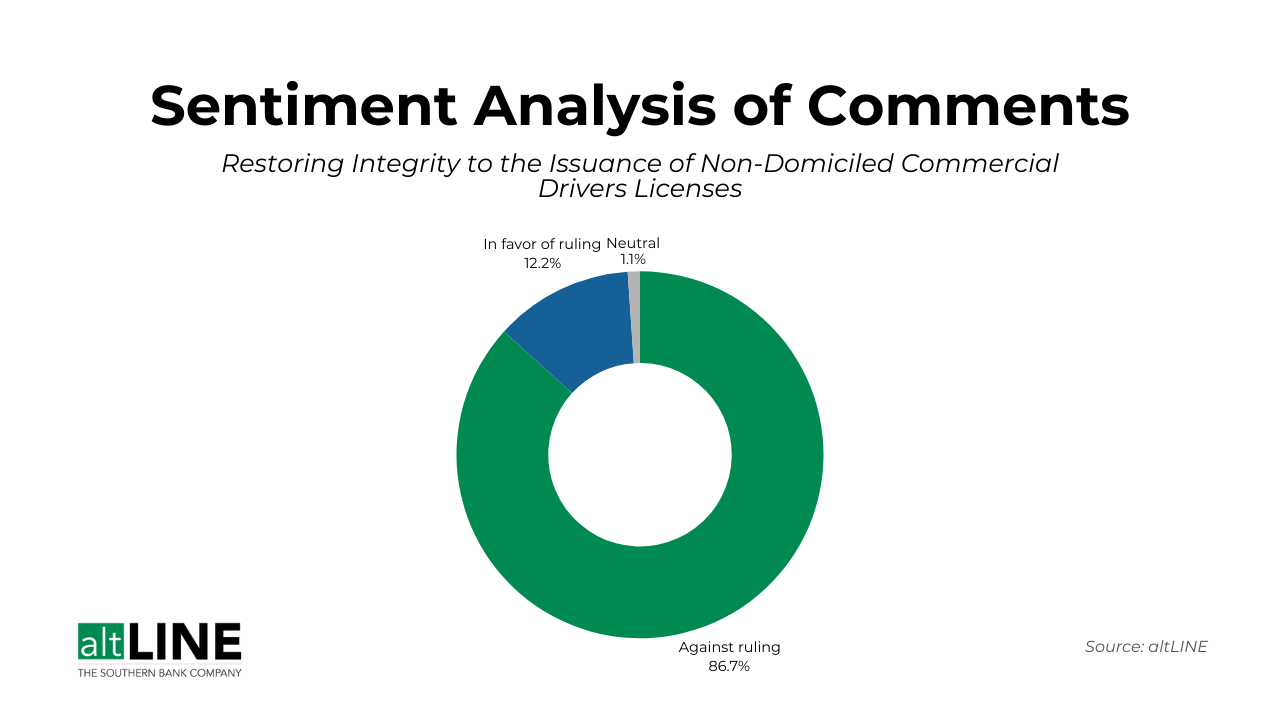
Only 12.2% of commenters were in favor of the rule. Supporters most often cited safety as their primary argument, as seen in the comment below.
“I strongly support FMCSA’s decision to stop issuing non-domiciled CDLs. As an experienced truck driver and small-fleet owner, I’ve personally witnessed how unqualified and poorly trained drivers create major safety hazards on America’s highways. Many can’t communicate in English, don’t know how to safely build air pressure before moving a truck, and often make illegal U-turns on restricted highways—endangering lives.”
Interestingly, those in favor of the ruling also cited their livelihoods as a reason to pass the rule. Many see the current state of the industry as negatively impacting the livelihoods of domiciled drivers with freight rates and wages dropping due to the saturation of non-domiciled participants. The following commenter explains this sentiment.
“I support the decision to revoke CDLs and not extend them for those without citizenship or a green card. The trucking industry is already under immense pressure — too many trucks on the road, freight prices dropping, and many American drivers struggling to make a living. Safety is also a major concern when drivers aren’t properly vetted or tied to the long-term well-being of this country. It’s time to put Americans first — we have plenty of qualified citizens and permanent residents who need these jobs. Prioritizing legal, stable employment is not just fair — it’s necessary for the long-term health of the industry and our economy.”
Commenters both in favor and against the rule suggested a variety of next steps, such as implementing exceptions for current non-domiciled CDL holders, extending the time before the rule goes into effect, and raising the standards for testing prior to issuing a CDL.
Common Exceptions Proposed
Many respondents urged FMCSA to create exceptions to the ruling for specific groups of legally present drivers. A particularly common request focused on Ukrainian refugees who arrived through the U4U (Uniting for Ukraine) program while fleeing war. Many individuals with Temporary Protected Status (TPS), Employment Authorization Documents (EAD), or DACA (Deferred Action for Childhood Arrivals), as well as those seeking asylum, requested an exception to be made to the ruling.
One commenter in the U.S. through the U4U program urged FMCSA to take into account the implications the ruling could have on Ukrainian refugees.
“I am a Ukrainian citizen who fled war. I have been working hard as a truck driver for two and a half years. I pay taxes. I work hard to support my family and to ‘keep America moving’. I am a safe driver. I speak good English. But now, with the publication of the new rule, I lose the opportunity to work as a truck driver, I lose the opportunity to support my family, I lose the opportunity to contribute to the US economy. I ask you not to deprive me of this opportunity and to allow me to work as a professional truck driver until my work permit expires.”
Similarly, many DACA recipients pointed out that, because they have lived in the United States for the majority of their lives, they are proficient in English and have legally obtained their CDLs, as noted in the following comment.
DACA recipients have been here since kids and thus [possess] high level proficiency in the English language. Furthermore, many have proven to be safe and professional drivers as records will show, some with entire families supported by the [DACA] recipient. Law-abiding DACA CDL holders should not be thrown in with the same group containing unsafe non-professionals, non-English speaking non-domiciled drivers.
These comments underscore the concern among drivers with temporary protections or work authorization. For many, the rule as currently written could prevent otherwise qualified individuals from maintaining their livelihoods, contributing to the economy, and supporting their families.
Advocates for these exceptions argue that non-domiciled drivers who already meet safety standards, have invested in training, and have made a positive impact on the U.S. economy should not be harmed by blanket restrictions.
Limitations and Considerations
While this analysis provides insight into how the FMCSA ruling was received by commenters, some limitations should be considered when interpreting results.
First, the use of AI-assisted classification introduces a degree of subjectivity inherent in interpreting open-ended public comments. Complex language, sarcasm, conditional statements, or incomplete submissions may have influenced how sentiment was categorized. However, validation testing showed strong agreement between automated and human review, suggesting these factors do not materially affect aggregate findings.
Second, argument and requested-action categories were defined in advance based on an initial manual review of comments. As a result, the analysis measures the prevalence of predefined themes rather than discovering entirely new ones, and some perspectives expressed outside of this framework may not have been captured.
Finally, the analysis did not include comments submitted with attachments. 19% of these excluded comments were from organizations, associations, and industry groups, and based on a manual review of this subset of attachments, organizations were more likely to be in favor of the ruling or neutral. Their exclusion may have caused results to slightly overrepresent opposition to the rule. Of the 8,009 comments, 259 contained attachments (3.2%) and were excluded.
These limitations should be considered when reviewing the findings and drawing conclusions from the data.
What Was the Sentiment From Noteworthy Industry Stakeholders?
Despite excluding comments with attachments from our analysis, our team manually sorted through PDFs that were uploaded by 50 organizations, including trucking associations, state and government officials, advocacy groups, training and educational organizations, and foreign government entities. We also analyzed standard comments (not uploaded as attachments) issued by several other industry groups in order to capture the most comprehensive view of opinions regarding the interim final rule.
The organizations included below were selected to represent a broad range of industry perspectives and stakeholder types. This ensures the analysis includes the full range of concerns, priorities, and arguments across different groups, providing the clearest picture of public input.
Owner-Operator Independent Drivers Association
The Owner-Operator Independent Drivers Association (OOIDA) submitted a comment in support of the rule, describing the rule as a long overdue response to safety issues involving non-domiciled CDL issuance.
OOIDA stated that the interim action, “delivers immediate licensing reforms that remove unsafe and unqualified drivers from the industry.” Todd Spencer, OOIDA President and CEO, argued that non-domiciled CDLs have been issued improperly in the past.
The comment also stated that “unqualified, foreign drivers are a critical safety risk on our nation’s roads” and rejected arguments focused on labor shortages or economic disruption.
Spencer cited that there is no true driver shortage, only high turnover driven by low entry standards and poor training. He claimed that this notion of a driver shortage has been used to justify putting unqualified drivers on the road and argued that safety must come first. Spencer emphasized that the rule will help raise safety standards and professionalism throughout the industry.
American Trucking Associations
The American Trucking Associations (ATA) also voiced support for the interim rule, praising FMCSA’s work to tighten CDL oversight.
“It reflects a thoughtful effort to restore nationwide uniformity in CDL credentialing,” the statement read.
ATA focused much of its comment on implementation and communication, urging FMCSA to ensure drivers and carriers receive timely notice when commercial licenses are downgraded or invalidated due to the interim final rule. ATA described employer notification as essential to highway safety, pushing for a national system that automatically alerts carriers whenever a driver’s CDL status changes. The organization also emphasized that, despite their support, the success of the proposed rule depends on consistent enforcement across all states.
Finally, ATA recommended additional long-term reforms, such as continuing to implement stricter English-language proficiency testing and stronger oversight of state licensing and CDL training providers, which is a sentiment shared amongst many who oppose the rule as well.
Teamsters California
Teamsters California, a state-level branch of one of the largest labor unions in the U.S., shared their opposition for FMCSA’s interim rule in a statement issued by Co-Chair Victor Mineros.
The union, which represents workers across dozens of industries, warned that the ruling would, “deprive Teamster members of their jobs and careers, impose financial burdens, and jeopardize the well-being and security of our communities.” The statement rejected FMCSA’s claims that the interim final rule would improve safety, noting non-domiciled CDL holders are highly qualified and essential to maintaining safe, reliable transportation.
More specifically, FMCSA’s claims that displaced drivers could easily find other jobs were heavily scrutinized throughout the statement. Mineros said these assumptions ignore research that shows job displacement leads to lower earnings and family disruption. He went on to reinforce the fact that their members deliver food, transport students, and provide other essential services, so removing these drivers would therefore delay deliveries, disrupt supply chains, and make communities less safe. Also mentioned were the remaining drivers who could be forced to be behind the wheel longer as a result of the lost drivers, making roads more dangerous.
“Thus, the Rule, which cruelly robs Teamster CDL drivers of their long-term careers, will result in more, not less, fatalities and overall cause a decline in community safety,” Mineros stated.
As a result, Teamsters California requested that FMCSA immediately withdraw the rule.
Embassy of the Federated States of Micronesia
The proposed non-domiciled rule even drew attention from foreign governments. The Embassy of the Federated States of Micronesia (FSM), for example, urged FMCSA to amend the rule, highlighting a gap in the interim final rule that could unintentionally bar its citizens from receiving non-domiciled CDLs.
FSM citizens live and work in the U.S. under the Compact of Free Association, a status the comment described as indefinite and “closer to lawful permanent residents than to individuals with a temporary immigration status.” The government stressed that because FSM citizens are not required to obtain a visa, the current CDL verification framework inadvertently disqualifies FSM citizens who otherwise meet all legal requirements to work and reside in the United States.
The comment urged FMCSA to amend the ruling, creating an exception to reflect their argument, citing that the same exception should be granted for passport holders of the Republic of the Marshall Islands and the Republic of Palau. FSM argued that, if no exception is made, the rule “fails to reflect the agreements between the governments” and blocks qualified drivers from accessing employment.
Oregon Department of Transportation
Several state government agencies also weighed in on the rule. Oregon’s DMV argued that FMCSA’s Interim Final Rule lacks a data-driven justification, noting that the agency itself admits that there is not sufficient evidence to “reliably demonstrate a measurable empirical relationship between the nation of domicile for a CDL driver and safety outcomes in the United States.”
Oregon highlighted that in nearly six years of data, zero fatal crashes in the state involved a non-domiciled CDL holder, calling into question the safety rationale for the sweeping restrictions.
The state also raised concerns about legal authority and economic impact. Oregon noted that the rule requires SDLAs to enforce federal immigration determinations, which falls outside of FMCSA’s mandate. They warned this could harm legally present temporary residents who rely on commercial driving for their livelihoods.
National Association for Pupil Transportation
The National Association for Pupil Transportation (NAPT) submitted comments expressing general support for FMCSA’s effort to strengthen oversight of non-domiciled CDLs, highlighting the value of clearer processes, stronger verification, and consistent state-level procedures. The organization also stressed that reliable licensing systems are essential to roadway safety, stating that, “clarity and consistency are essential to safety,” particularly for students who rely on school transportation.
NAPT encouraged FMCSA to continue providing direction to the states so reviews can be completed efficiently and licensing activity can resume without unnecessary delay.
Alliance for South Asians Taking Action (ASATA)
The Alliance for South Asians Taking Action (ASATA) issued a response opposing the interim rule, requesting it be rescinded immediately.
ASATA argued the decision will “deprive 194,000 drivers of their livelihoods” despite being properly trained and legally authorized to work in the United States. The organization pointed to language within FMCSA’s own rule text, noting there is no “measurable empirical relationship between the nation of domicile for a CDL driver and safety outcomes.” The organization believes qualified truck drivers should not be disqualified solely because of their non-domiciled status, as it does not reflect their qualifications or ability to drive safely.
Sikh Coalition
The Sikh Coalition, a nonprofit organization that works to protect the civil rights and religious freedoms of Sikh Americans, strongly opposes the interim final rule, pointing to its disproportionate impact on Sikh and other immigrant truck drivers. According to their statement, many of the estimated 150,000 Sikh drivers nationwide rely on non-domiciled CDLs to earn a living.
In its comment, the Sikh Coalition said the rule would devastate immigrant trucking communities without improving public safety, noting FMCSA’s own estimate that nearly 194,000 of 200,000 non-domiciled CDL holders could lose their licenses. “These drivers are being deprived of their licenses, and, in turn, their livelihoods, despite being lawfully present and authorized to work in the United States,” the organization wrote.
In addition to arguing the rule’s discrimination based on immigration status, the Sikh Coalition also expressed concern over the potential impacts of implementing the rule, including an exacerbation of the driver shortage and increased safety risks by forcing unaffected drivers to work longer hours while fatigued.
Due to these potential impacts, the coalition requested FMCSA rescind the rule.
Easy CDL Trucking School
Independent training organizations also weighed in. Easy CDL Trucking School criticized FMCSA’s rule as contradictory, noting that while the agency claims the goal is public safety, they made the CDL exam easier in 2024, removing skill requirements like checking brake components and performing 90-degree alley dock parking. The school argued that the real issue involves FMCSA lowering the bar for the examination, citing flaws in third-party testing that includes letting private schools administer exams, thus allowing individuals to obtain a license in just a few days, rather than spending weeks in proper training.
Implications: What’s Next?
The sentiment analysis shows a clear disconnect between FMCSA’s stated goals of improving safety and the concerns of drivers, carriers, organizations, and advocacy groups. The temporary court-ordered pause provides an opportunity for stakeholders to influence potential revisions. FMCSA’s public comment period may also inform future modifications or clarifications, particularly around administrative burdens and eligibility requirements.
For carriers, the comments highlight the importance of proactively monitoring driver eligibility, updating documentation, and preparing for potential workforce disruptions. For drivers, staying informed about legal developments and maintaining up-to-date immigration and employment records is essential.
As the situation evolves, the trucking industry faces significant uncertainty. Our analysis shows that the majority of responses are against the rule, with widespread concern about drivers’ and carriers’ ability to earn a living, fairness in how the rule impacts various groups, economic impacts, and potential workforce disruption. The coming months will likely determine whether the interim rule remains in effect or is adjusted to address the concerns voiced by the community.
In-Summary
FMCSA’s interim ruling on non-domiciled CDLs has produced strong reactions across the trucking sector. While safety and regulatory integrity remain constant objectives, the sentiment analysis suggests that many drivers and carriers feel the ruling is overly restrictive and potentially harmful. Public feedback and legal developments will be key factors in determining the rule’s final outcome, and all stakeholders should continue to monitor developments.

Michael McCareins is the Content Marketing Associate at altLINE, where he is dedicated to creating and managing optimal content for readers. Following a brief career in media relations, Michael has discovered a passion for content marketing through developing unique, informative content to help audiences better understand ideas and topics such as invoice factoring and A/R financing.