
Last Updated September 9, 2026
Late payments are a familiar challenge for any business that issues invoices, but they can hit small businesses far harder. When cash flow is already tight, an overdue invoice can affect investment, opportunities for growth, and even a business’s ability to keep operating.
To understand the scale of the problem, we first explored official data and conducted our own survey of SME owners to examine how late invoices affect businesses in practice, how well they can absorb payment delays, and what happens when those delays become prolonged.
The findings show how quickly a common payment problem can become a much more serious financial risk.
Current SME Survivability
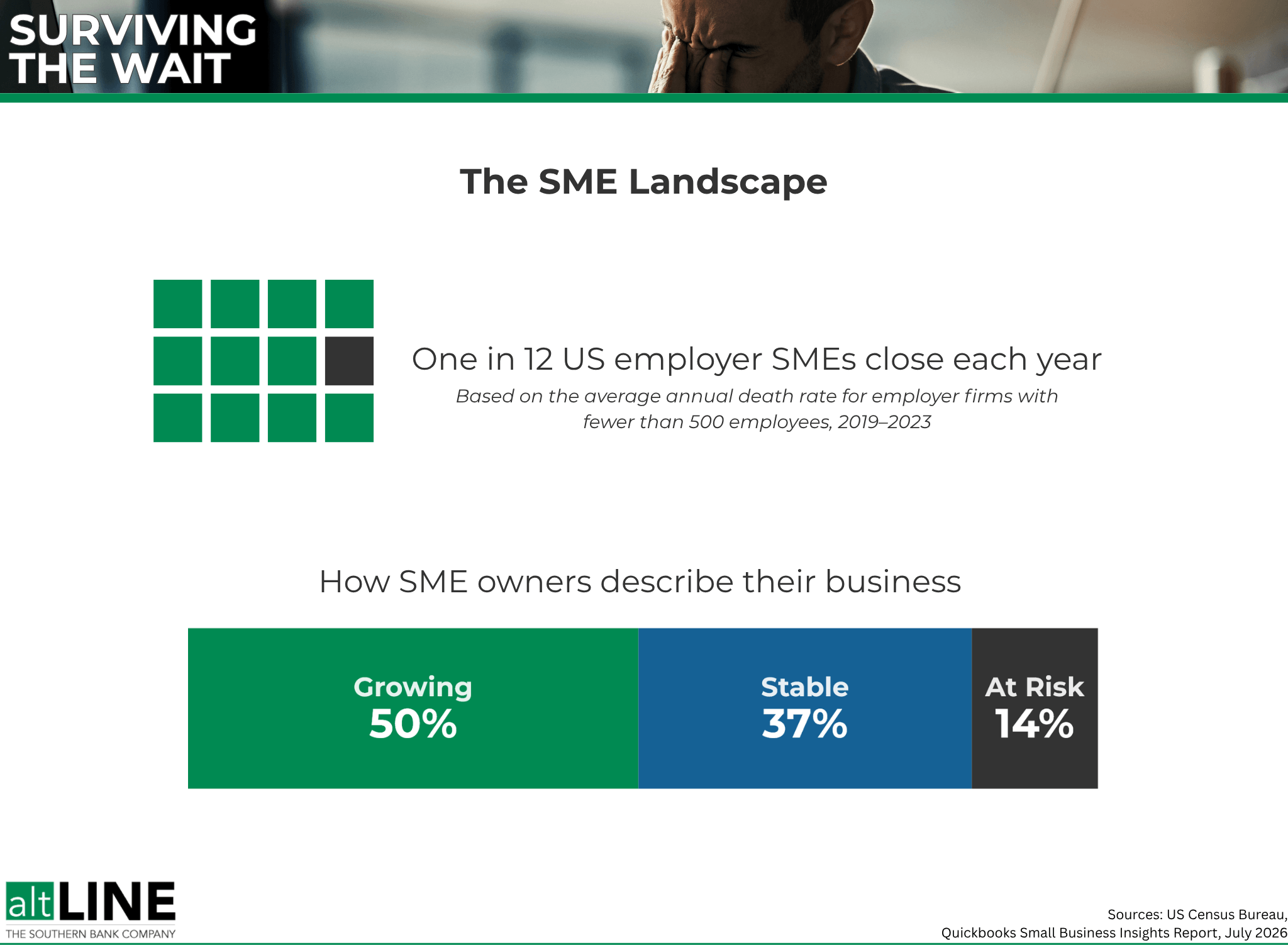
Owning a small business often comes with significant financial pressure. U.S. Census Bureau data shows that, between 2019 and 2023, annual SME closures averaged 8.2% of employer firms (defined here as businesses with fewer than 500 employees). For the smallest businesses, with fewer than 10 employees, that figure rises to 10.1%. That’s one in ten businesses with fewer than 10 employees closing every year.
Worse, from 2016 to 2023, the SME closure rate gradually rose from 7.4% to 9.4%, suggesting that the pressure small businesses are under has only been increasing.
Small business owners appear well aware of that pressure, according to a study by QuickBooks. While half of small business owners say their business is growing and a further 37% describe it as stable, 14% say their business is financially at risk.
With a sizable minority of SMEs already under financial strain, the next question is what is applying that pressure.
Difficulties With Cash Flow
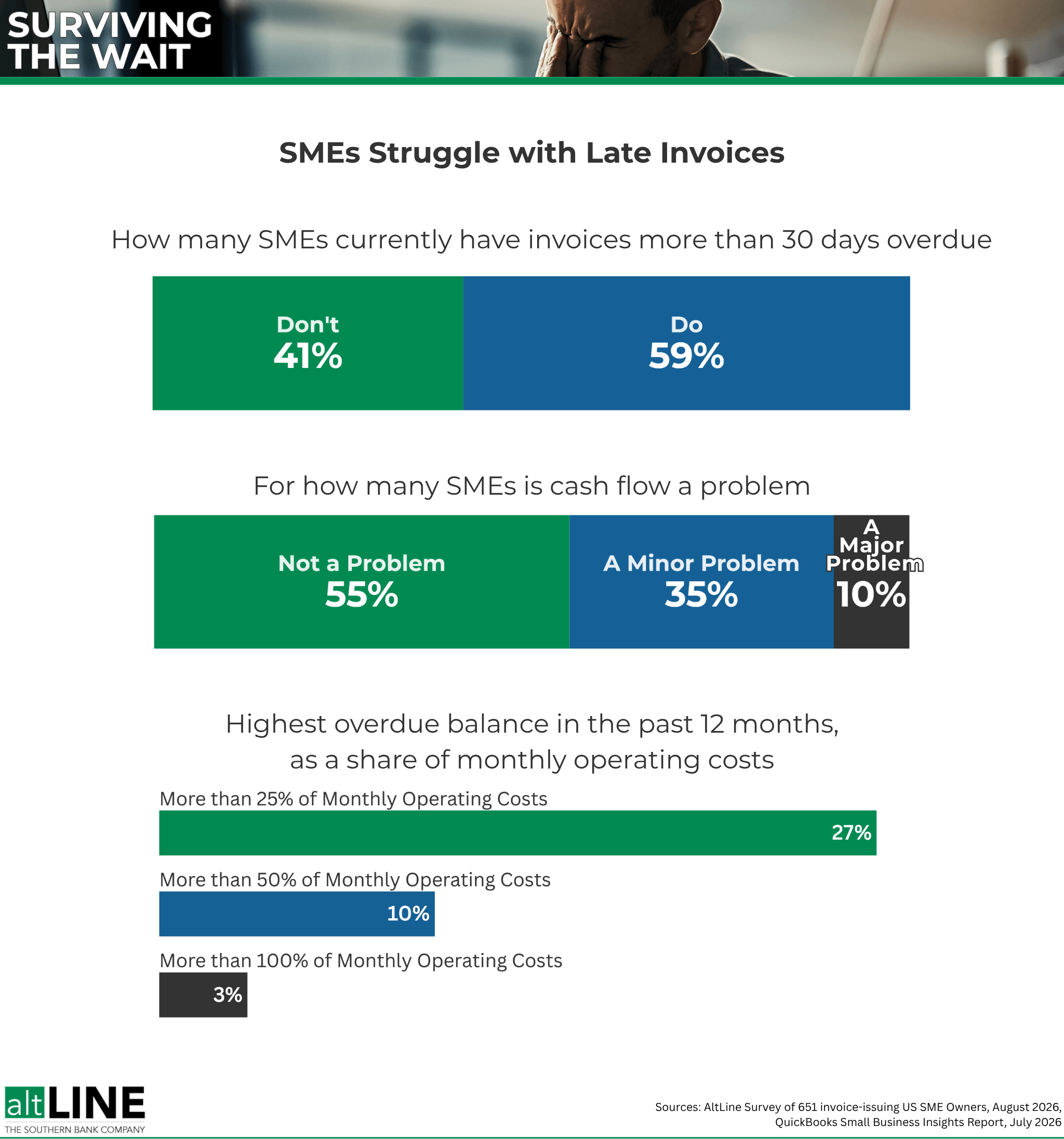
Restricted cash flow can be a major source of financial pressure, particularly for small businesses. QuickBooks’ small business survey found that cash flow is a problem for 46% of SMEs, including 10% who describe it as a major problem. At the same time, three in five SMEs currently have invoices that are more than 30 days overdue.
Our own survey explored how severe that problem can become. At the point in the past year when late customer payments had the greatest impact, one in ten SMEs had overdue invoices worth more than half of their average monthly operating costs.
The data shows that many SMEs struggle with late payments, putting pressure on cash flow and adding to wider financial strain, but what are the specific impacts of these delays?
The Damage of a Late Invoice

We asked SME owners who had received late payments in the last year what consequences they had faced as a result. Just 12.2% said late payments had no significant impact on their business, meaning almost nine in ten felt the effects in some way.
Many owners chose to cover the shortfall themselves; more than a third used personal savings to support their business’ cash flow. Others saw a direct impact on the growth of their business, with 11.5% postponing hiring, investment, or expansion.
We also asked how late invoices limit what businesses could otherwise achieve. Only 13.5% believe nothing about their business would change if customers always paid on time, while 35% say they would be able to invest in better equipment or technology.
Delayed growth is one consequence of late payments, but for SMEs with limited cash reserves, prolonged payment delays can pose a much more serious threat.
The Maximum Delay
We’ve established that late payments are relatively common for SMEs, but how well can businesses absorb these blows when they occur?
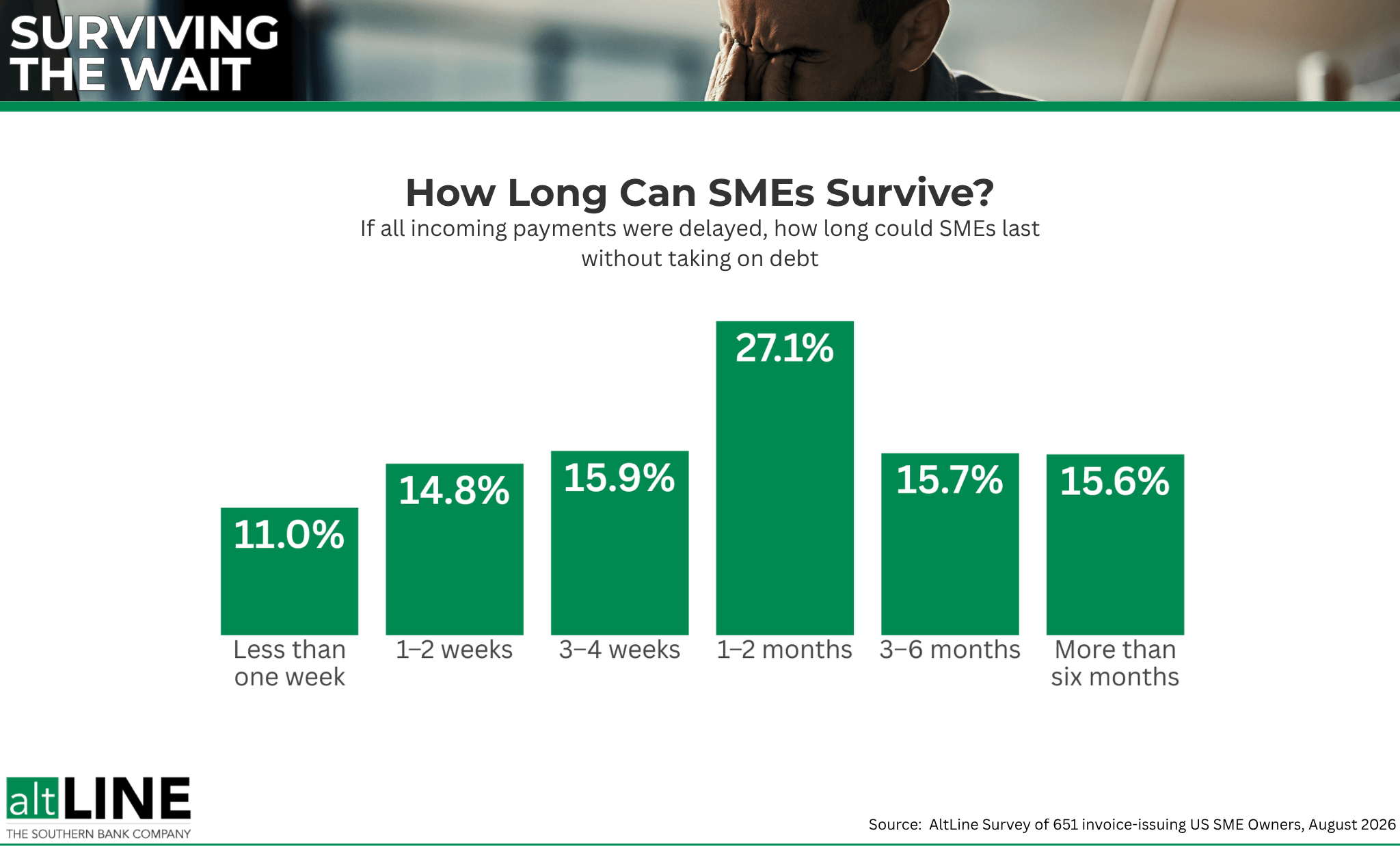
Our analysis revealed that more than two in five SMEs say they could not cover a full month of essential operating costs if all incoming payments were delayed, without turning to financing, taking on debt, or liquidating assets.
For some, the buffer is much smaller: 10% say they could not cover even a single week of essential costs without support.
This hypothetical assumes a worst-case scenario in which an SME experiences payment delays across the board; SMEs with only a small number of significant customers can be highly exposed to a single late-paying client. This exposure is what we explored next.
The Damage a Single Customer Can Cause
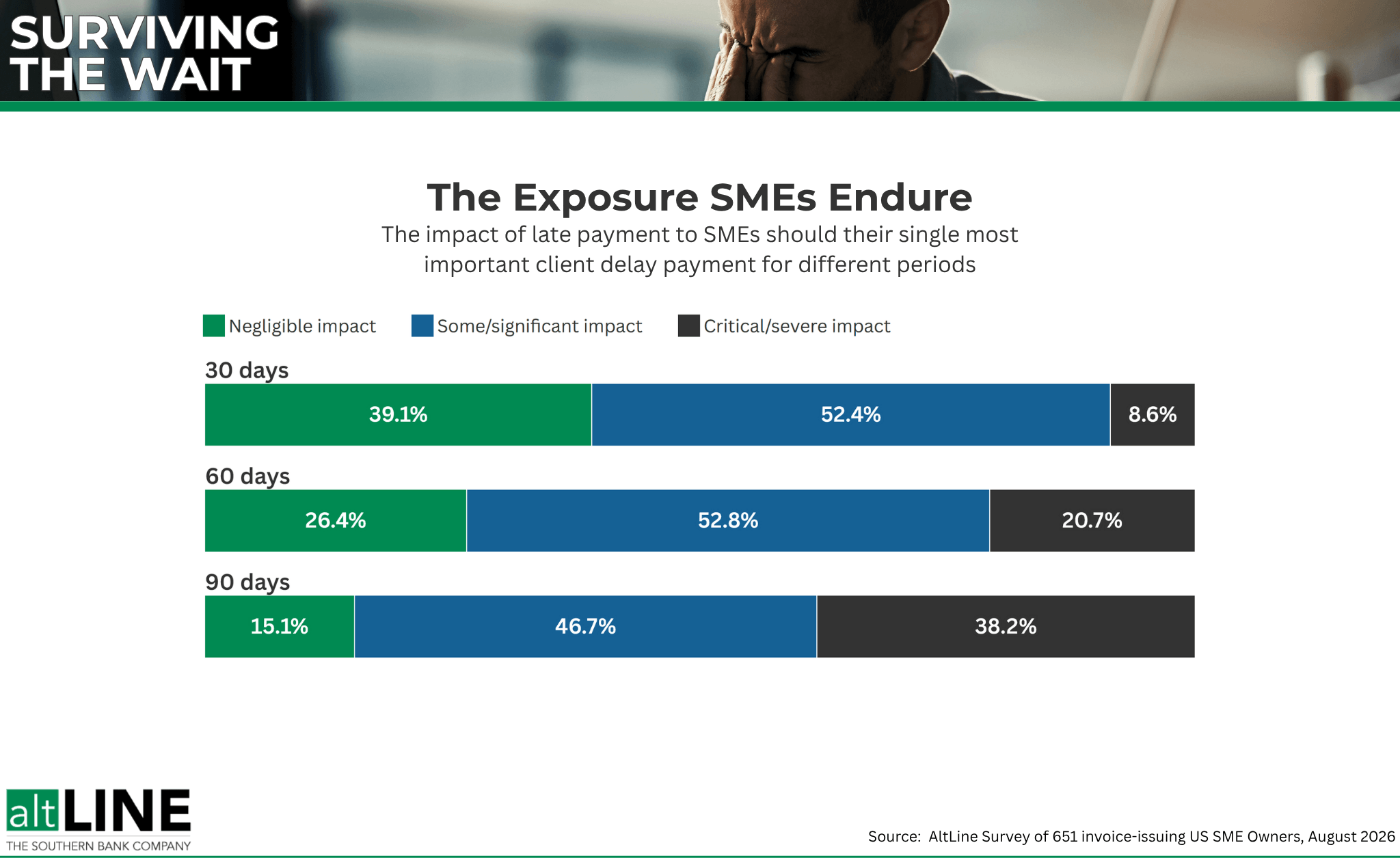
The impact of a single late-paying customer can escalate quickly. Just shy of 1 in 10 SME owners say a 30-day delay from their most significant client would have a critical or severe impact on their business. When asked for more detail, 6% said it could cause missed payments or reduced operations.
Most strikingly, the other 2% said that a delay of just 30 days from their largest client could be serious enough to make them consider permanent downsizing, selling, or even closing the business.
If that delay stretches to 90 days, the risk rises sharply. More than a third of SME owners say the impact would then be critical or severe. Around 22% added they would likely miss payments or have to reduce operations, while 15% said they would consider permanent downsizing, selling, or closing.
Conclusion
Owning a small business comes with plenty of challenges, financial pressure, and risk. Late payments may not be the only, or even the biggest, problem SMEs face, but they can make an already difficult situation significantly worse. For businesses operating with limited cash reserves, even a relatively short delay can restrict investment, force owners to use personal savings, and make it harder to meet their own obligations.
Our survey shows how quickly those effects can escalate when payments dry up or when an important customer struggles themselves. For some businesses, even a 30-day delay can become serious enough to threaten their future.
For a small business to grow successfully, it needs stable, available cash flow but also a way to manage when that cash flow is jeopardized by late payments.
Methodology
To establish the wider context around small business survival and late payments, we first reviewed existing third-party data.
We used U.S. Census Bureau Business Dynamics Statistics to examine annual firm deaths between 2019 and 2023, focusing on employer firms with fewer than 500 employees.
We also used published data from QuickBooks Small Business Insights to understand what is already known about the financial pressures facing small businesses.
To explore the issue in greater depth, we conducted our own survey in August 2026 of 1,000 U.S.-based SME owners whose businesses employed fewer than 250 people.
Of these 1,000 respondents, 349 were excluded from questions relating specifically to late invoices because their businesses had not issued any invoices during the previous 12 months. Findings on the impact of late payments are therefore based on the remaining 651 eligible respondents.
Throughout the report and where applicable, respondents who selected “Not sure” were excluded from percentage calculations. These responses accounted for no more than 3.2% of responses to any reported question.

Michael McCareins is the Content Marketing Associate at altLINE, where he is dedicated to creating and managing optimal content for readers. Following a brief career in media relations, Michael has discovered a passion for content marketing through developing unique, informative content to help audiences better understand ideas and topics such as invoice factoring and A/R financing.